How to choose the most appropriate Metal Bond Diamond tools for Grinding Concrete Floors
This article explains how to choose the right metal bond tool for your walk behind planetary floor grinder. The same principle applies to single discs and hand grinders.
Diamond tools are expensive. Therefore, it’s not possible to stock all the different varieties that are available in the market. When there are so many different shapes, different bond hardness and different grits. How do you know which one to keep in stock and/or buy.
Only with experience, you will be able to make the best decision for the type of concrete that you are grinding and what works best with your particular machine.
Grit size (the smaller the number, the larger are the diamonds)
Choosing the grit is quite simple. The larger the size of the diamonds, the deeper is the scratch and the more material you are going to remove.
But not that simple.
Smaller diamonds tend to be sharper than bigger diamonds. So depending on the weight of your machine and the surface area of the segments, the 30# may remove just as much and just as fast as the 16#. For this reason we don’t bother stocking the 16#. If you need something larger to remove paints and adhesives, use PCDs.
Depending on your machine and the concrete, you may also be able to use PCDs for the initial grind to get the job done faster.
To do a grind and mechanical polish, start with a 30# to remove the top layer and expose the aggregate. Continue with a 60# to remove the scratches left behind from the 30#. Grout with 120#.
To do a hone and seal, start with a 30#. Then proceed depending on the slip resistance and finish required.
Bond Hardness (the harder the concrete, the softer the bond required)
Keep in mind that the diamonds do the grinding and the metal is there to hold the diamonds.
You need to choose a metal bond that wears slowly so that the diamonds remain exposed. But does not wear so fast so that your wasting your money. The softer bond will wear faster than the a harder bond. Therefore, sometimes you may like to start with a metal bond that is harder than what you think you may need. Move to a softer bond, if you find that the harder bond becomes glazed and stops working.
Too much friction will cause the metal to overheat and expand, covering the diamonds. Your tools will then slide over the concrete instead of grinding it.
The tell tail signs are :
1) When pushing the machine you can feel it through your hands whether it’s grinding or sliding.
2) The machine is drawing less amperage then it would normally do.
3) No dust left behind on the floor
4)Glazing on the surface of the segments and
5) Burn signs on the tools and the tools are too hot to touch
To remedy this problem, you will need to use a softer bond and/or a slower speed and/or decrease the weight. To remove the glazing, run the machine on the opposite direction and/or throw some sand in front of the machine. Adding water helps to cool the segments thus keeping them sharp. If you are struggling to expose the aggregate, add water.
With new slabs that have been laid for the purpose of grinding and polishing, the aggregate should be evenly distributed and the hardness of the concrete should slightly increase as you expose more of the aggregate. The soft mortar that’s holding the aggregate will help keep the tools sharp. Therefore on concrete that has been recently laid (1 to 2 weeks depending on weather) start with a hard bond. On older concrete (3 to 4 weeks) start with a medium bond.
Old slabs are a completely different ball game. The hardness of the concrete will vary as you grind. This is more prominent in older slabs. If the concrete is well trowel, there will have a very hard crust which is not even, maybe revealing a soft mortar underneath. This hard crust will not wear evenly so you may create hard and soft patches and to complicate things, the machine may dig into the soft patches. You will eventually expose the aggregate which will be harder than the mortar holding it together. But to further complicate things, the hard aggregate will not be evenly distributed. I wish you good luck. A bigger machine with a higher number of tools will help to keep the floor level.
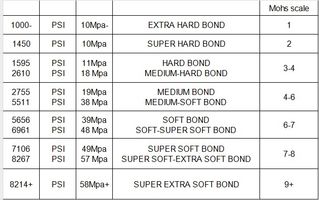
The following table will help you choose the required bond harness.
First paragraph